Fiddler on the Roof: From Exile to Home

Updated: Sep 2

Long before there was a State of Israel, there was Tevye. He was not a thinker or a politician, just a poor milkman trying to hold his family together as the world around him was crumbling.
Tevye was created by Shalom Aleichem, the pen name of Sholem Rabinovich, a Jewish writer who lived in the Russian Empire (today Ukraine) and wrote primarily in Yiddish.
Shalom Aleichem didn’t write about ideology. He wrote about life as it was lived, with sharp, self-aware humor. Tevye appears in a collection of stories, and as he tries to make sense of an uncooperative world, he captures the voice, humor, and struggles of everyday Jewish life. Tevye’s humor is how Jews coped with poverty, uncertainty, and a world that no longer looked familiar. These stories later became the basis for Fiddler on the Roof.
The world of the shtetl had endured for generations, but by the late 19th century it was beginning to unravel under the pressure of economic hardship, declining religious commitment, and powerful new ideologies such as socialism, secularism, and nationalism that pulled younger Jews in different directions. The old frameworks were weakening, yet one constant remained: antisemitism - in the worst cases backed, and in the best cases tolerated, by the authorities.
Tevye feels that tension within his own home, as his daughters make choices that challenge everything he had assumed would continue unchanged. He tries to hold on to the world he knows, but the ground beneath him is shifting. Eventually, the Jews of his village are forced to leave, reflecting the broader reality of pogroms, restrictions, and expulsions that were making Jewish life in the Russian Empire increasingly untenable. At that point, Tevye’s story stops being about how to live in the shtetl and becomes an acknowledgment that Jewish life there has no future.
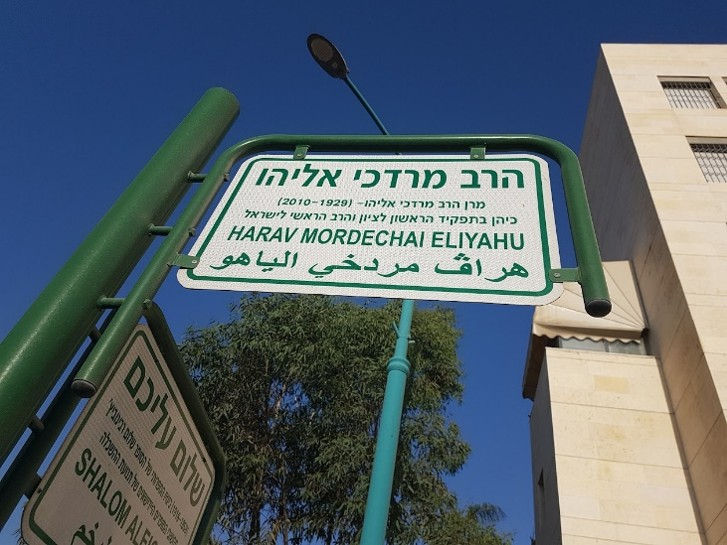
Today, Shalom Aleichem’s name appears on a street in Talbieh, Jerusalem. Nearby streets are named for Leon Pinsker and Chovevei Zion, which represent the other side of the story: the response to Tevye’s reality that had become unsustainable.
Pinsker was born in 1821 in Russian-controlled Poland. He initially believed that integration could solve the Jewish problem. He studied law and then medicine, and became a leading figure encouraging Jews to adopt Russian culture in the hope of acceptance.
But Russia’s state-sponsored pogroms of 1881 changed that. Pinsker came to see antisemitism not as a passing problem, but as a permanent reality. Jews, he realized, were viewed as outsiders everywhere, never fully accepted and always vulnerable. In 1882, he published Auto-Emancipation, arguing that Jews could not rely on others for acceptance and would need to take control of their own future through a homeland of their own.
That idea led to the creation of the Chovevei Zion movement, in which Pinsker was a founder and later chairman. The movement quickly grew to thousands of members across Eastern Europe. They began establishing early agricultural communities in Eretz Yisrael, including Rishon LeZion and Zikhron Ya'akov. These small beginnings marked a shift: For the first time, the response to Jewish vulnerability was not adaptation or acceptance but relocation.
Seen together, these names tell a single story. Shalom Aleichem captures what Jewish life looked like as the old world began to unravel, while Pinsker explains why the status quo in Europe could no longer continue. Chovevei Zion represented the first organized attempt to build something different.
People often assume the story of modern Israel began with Theodor Herzl. But by the time he appeared more than a decade later, the conclusion had already been reached and the wheels of change were in motion. For millions of Jews, life in Europe was untenable.
These streets in Talbieh represent a breaking point and a new beginning.
Today, nearly 150 years later, many Jews once again sense shifts in the global climate that leave them feeling exposed and vulnerable. The difference is that the existence of Israel ensures that Jews are no longer entirely at the mercy of others. This time, we have a home.
Gedaliah Borvick is the founder of My Israel Home (www.myisraelhome.com), a boutique agency that guides overseas buyers through the complexities of purchasing and selling homes in Israel. To receive his monthly market updates, contact him at gborvick@gmail.com.