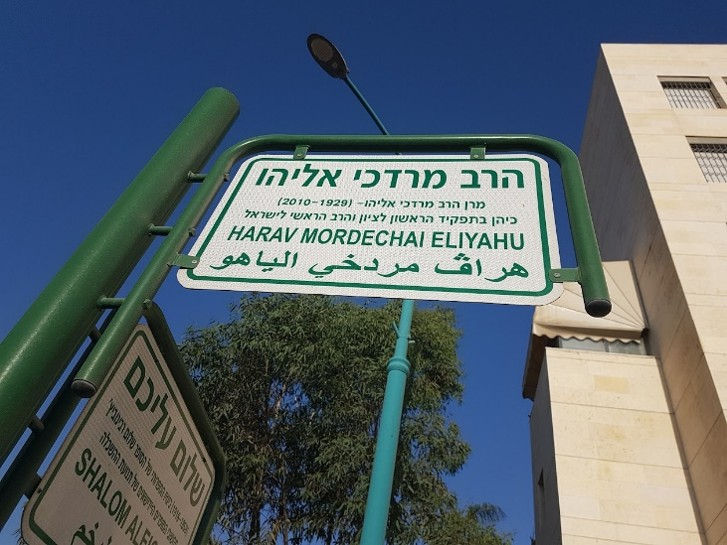
Where Torah and State Meet


Tucked into the neighborhood of Bayit Vegan, a Jerusalem street bears the name Yitzchak (Isaac) Breuer (1883–1946) - jurist, philosopher, and grandson of Rabbi Samson Raphael Hirsch - whose ideas helped frame a distinctly Orthodox response to Jewish statehood. Naming a street for Breuer honors the thinker who insisted that the return to Zion would matter only if the homeland were governed by Jewish law.
Born in Pápa, Hungary, and raised in Frankfurt, Breuer absorbed his grandfather’s doctrine of Torah im Derech Eretz - the integration of Torah and worldly life - and recast it for a national stage. Where Rabbi Hirsch sought harmony between faith and modern culture, Breuer envisioned Torah im Derech Eretz Yisrael: a Jewish society in which Torah would guide public, legal, and civic institutions.
After earning rabbinic ordination and a doctorate in law, Breuer became a leading thinker in Agudat Yisrael and later headed Poalei Agudat Yisrael. When the Nazis rose to power, he immigrated to Jerusalem in 1936, representing
Orthodox Jewry before the British Peel and Anglo-American Commissions and advocating for a Torah-based Jewish society.
Breuer’s stance toward Zionism was complex but principled. He opposed secular Zionism, which he believed sought to construct a Jewish state without a Jewish soul - yet he refused to ignore the unfolding drama of Jewish history. He admired Herzl’s determination to restore Jewish nationhood, but insisted that ultimate authority must belong not to political institutions, but to Torah itself. The Balfour Declaration and the rapid growth of the Yishuv convinced him that divine opportunity was at hand. He called this a “legitimate revolution”: not reshaping Torah to fit modern realities, but reshaping modern realities so they could conform to Torah.
This conviction placed Breuer between two camps. He rejected the isolationism of ultra-Orthodox groups that withdrew from national life without offering a constructive vision, and he criticized religious Zionists who, in his view, risked sanctifying the state above halacha. Instead, he charted a middle course: active participation in building the land, coupled with unwavering commitment to Torah as the foundation of public law, economics, and culture.
To give this vision practical form, Breuer proposed the creation of Bina La’ittim, an institute to train rabbinic scholars fluent in the real-world needs of a modern society - from agriculture to municipal governance. He did not live to see the declaration of the State of Israel in 1948, but his final years were devoted to preparing for it. For Breuer, the Jewish nation must be an Am HaTorah - a country bound by divine law. Only Torah, he believed, could prevent Jewish national rebirth from becoming spiritually hollow.
Walking down Yitzchak Breuer Street today, surrounded by yeshivot and schools, one can feel how his challenge still reverberates. Israel continues to wrestle with the relationship between religion and state, between timeless law and modern power - questions Breuer confronted long before independence.
Isaac Breuer was not a Zionist in the political sense, but he was a revolutionary in the deepest Orthodox sense. He saw the upheavals of the twentieth century - migration, the British Mandate, and statehood itself - not as reasons to dilute Torah, but as opportunities to realize it in public life. Naming a street after him in Jerusalem is more than a tribute. It is a reminder of his enduring challenge: to build a Jewish society in which eternal halacha, not the mood of the moment, remains sovereign.
Gedaliah Borvick is the founder of My Israel Home, a real estate agency focused on helping people from abroad buy and sell homes in Israel. To sign up for his monthly market updates, contact him at gborvick@gmail.com. Please visit his blog at www.myisraelhome.com.